
We will be present at the Sessions for Poster Presentation at the conference.
Abstract
Framework Vocal Development: Making Learning Processes Accessible
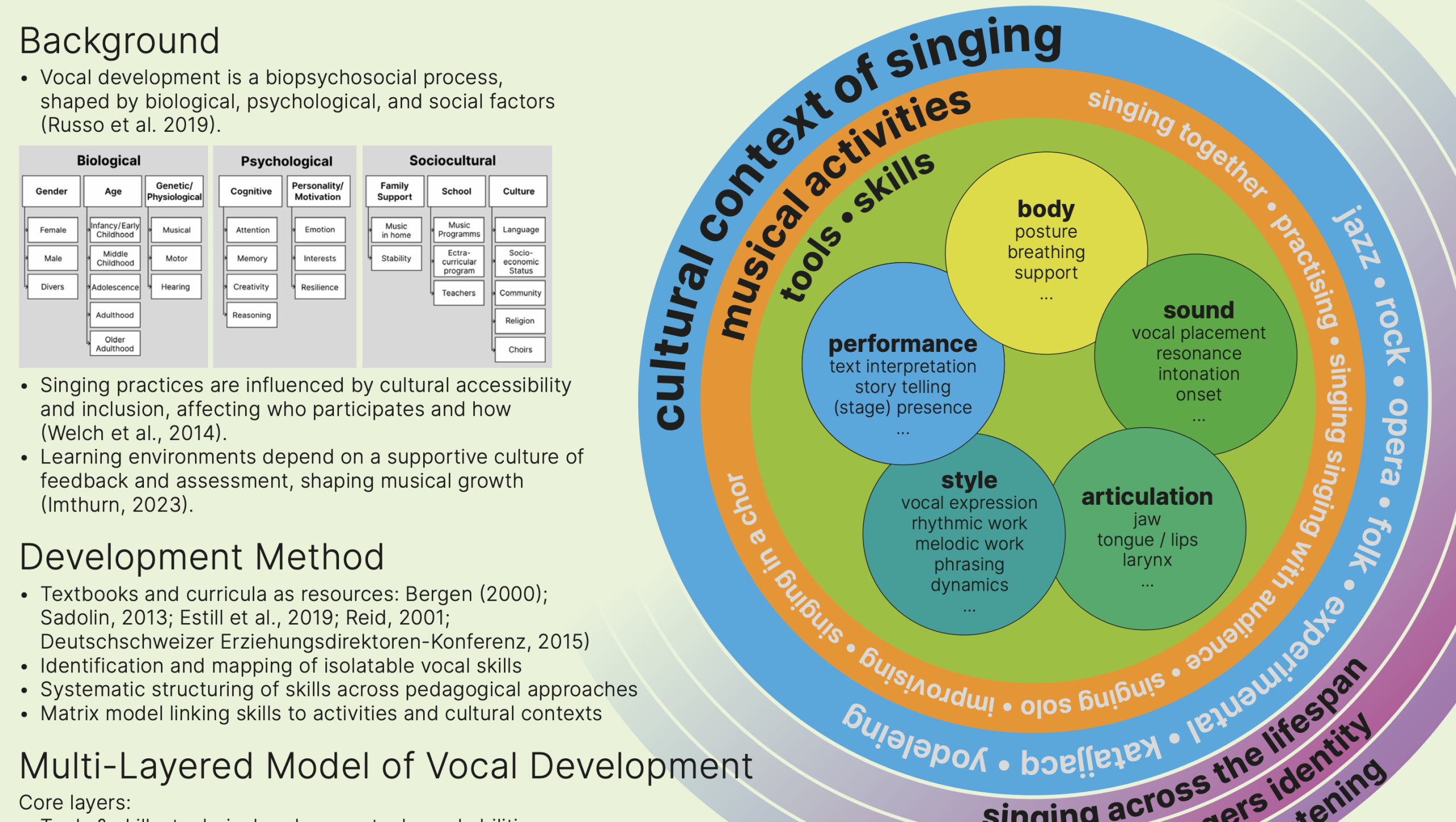
Singing can be one of the most accessible forms of musical expression. In a society of singularities (Reckwitz, 2020), the question arises of how singing can be fostered, whether in school classes, youth choirs or for individuals. Diverse biographies influence personal approaches to singing, and opportunities for vocal development are unevenly distributed across social and cultural (cf. Welch et al., 2014) as well as school (Imthurn, 2023) contexts. While many textbooks about vocal development exist (e.g. Sadolin, 2013), a structured approach to vocal learning that makes the complex work of voice training more accessible through visualisation is lacking.
The Framework Vocal Development (FVD) responds to this need. It builds upon the biopsychosocial model of influences on the development of singing proposed by Russo et al. (2019), complemented by pedagogical models from various schools of singing. Structurally, the framework is organized in three concentric circles. At its core, five domains are distinguished: Body, Sound, Articulation, Style, and Performance. Each domain describes skills that can be developed more or less independently. The second circle depicts musical activities, such as singing alone or with others, or for an audience. Finally, the outmost circle focuses on the cultural embedding of singing.
This approach enables people of all experience levels to participate in suitable vocal activities. A central application of the FVD is the creation of a personal map of singing, visualizing existing resources and potential areas for growth. Importantly, the framework does not imply a linear progression of competence but supports multiple entry points through the interplay of skills, attitudes, playful exploration and knowledge.
Initial applications in teacher education and expert feedback suggest that the FVD functions as both an analytical tool and practical guide, while further development requires broader cultural and educational input. This contribution is presented as a poster.
Gabriel Imthurn is a professor of music education at the FHNW School of Teacher Education in north-western Switzerland. After studying Piano and School Music at the Zurich University of the Arts, he taught at secondary schools for over two decades. He completed his doctorate on the assessment of singing at the University of Music, Drama and Media in Hanover.
Vera Baumann holds a master’s degree in Music (voice and jazz performance at the University of Applied Sciences and Arts Lucerne) as well as a master’s degree in secondary education at the University of Teacher Education Lucerne. She is a voice teacher at the FHNW School of Teacher Education in north-western Switzerland and has taught in secondary schools for over ten years.
